
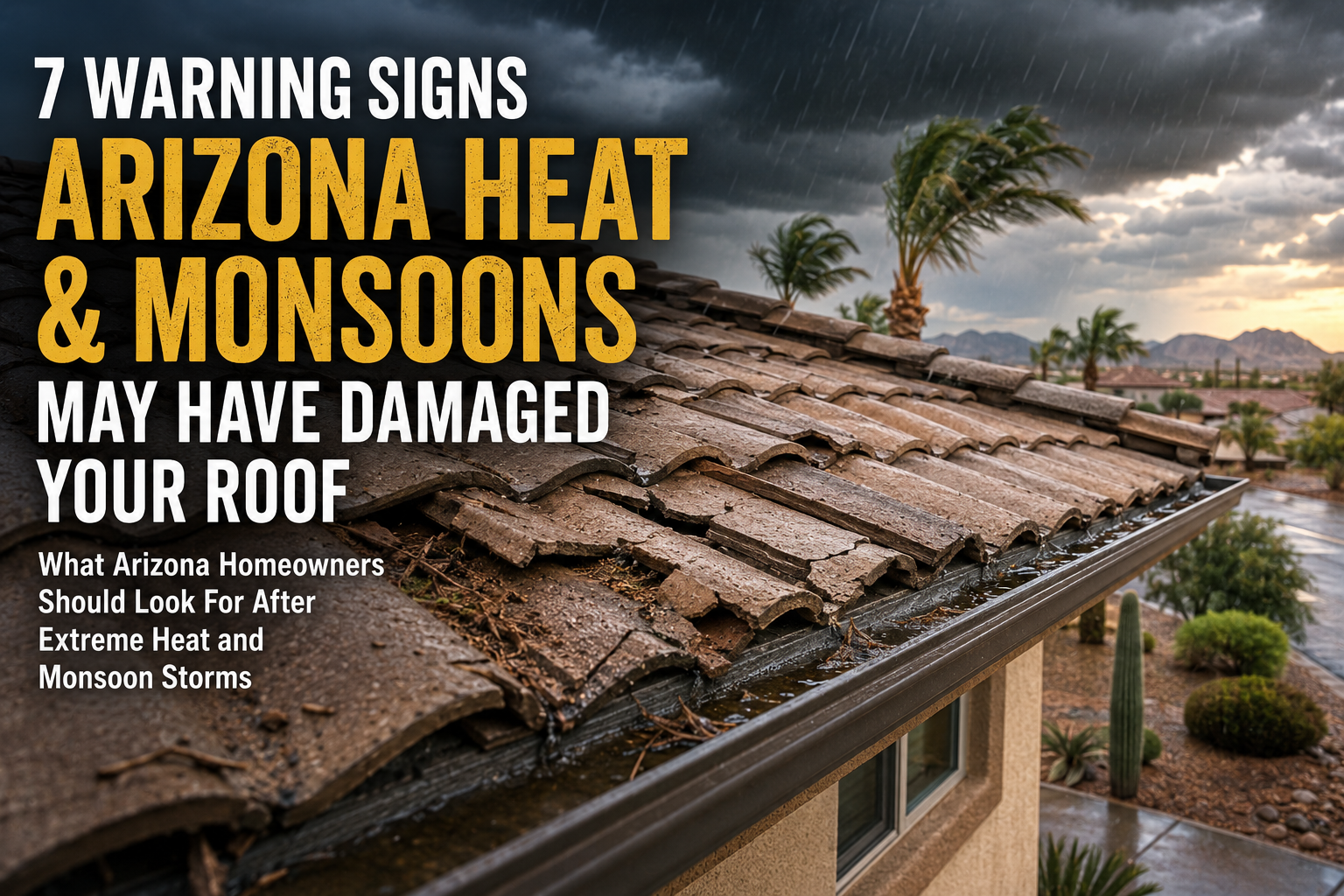
Arizona roofs deal with a punishing combination of intense summer heat, prolonged UV exposure, dust, strong monsoon winds, blowing debris, and sudden heavy rain.
A roof can look perfectly normal from the driveway while small problems are developing around tiles, shingles, flashing, sealant, vents, gutters, and roof edges. Once a strong monsoon storm arrives, those weak spots can become opportunities for water to enter the home.
The National Weather Service’s Arizona Monsoon Safety guidance warns that thunderstorms in the Southwest can produce strong winds, blowing debris, lightning, and flash flooding. That makes it especially worthwhile to check your property after significant storms.
The challenge is knowing what homeowners can safely inspect themselves—and which warning signs mean it is time for a professional roof inspection.
Here are seven signs Arizona heat and monsoon weather may have damaged your roof.
1. You Can See Cracked, Broken, or Missing Tiles or Shingles
Start with the most visible portion of the roof.
Stand far enough away from the house to get a clear view without climbing onto anything. Binoculars or the zoom function on your phone can help you inspect questionable areas from the ground.
Look for:
- Cracked roof tiles
- Broken tile corners
- Missing tiles
- Torn or damaged shingles
- Bare-looking sections
- Roofing pieces on the ground
- Areas that look different from the surrounding roof
Heat exposure and ordinary aging can gradually affect roofing materials, while monsoon winds and flying debris can create additional damage.
If you find a tile fragment or roofing material in your yard after a storm, try to determine whether it came from your home rather than assuming it is harmless debris.
Drum Tight Roofing & Restoration works with tile, shingle, foam, and coating roofing systems and provides professional roof inspections in Arizona.
Take photos from the ground
Photograph anything that looks questionable.
Those photos give you something to compare after another storm and can also help a roofing professional understand what you are seeing before an inspection.
2. Roofing Materials Look Lifted or Out of Position
Strong monsoon winds do not always remove roofing material completely.
Sometimes a storm loosens or shifts it.
From the ground, look for:
- Shingles with raised edges
- Tiles that appear shifted
- Sections that do not sit evenly
- Roofing that suddenly looks irregular
- Pieces that appear partially displaced
- Roof edges that look different after a storm
The National Weather Service notes that Arizona monsoon thunderstorms can produce powerful downburst and straight-line winds capable of damaging property.
Even if a tile or shingle is still attached, a shifted section may expose materials underneath to wind-driven rain.
Do not climb up to reposition it
It may be tempting to climb onto the roof and move a tile back into place.
That’s not a good idea.
Arizona roof surfaces can be extremely hot, and roofing materials may be slippery, brittle, loose, or already damaged.
Walking across a tile roof incorrectly can also create additional breakage.
If roofing materials appear displaced, Drum Tight Roofing’s inspection services can help determine whether repairs are necessary.
3. Flashing Around Roof Openings Appears Damaged
Flashing helps protect vulnerable transitions and penetrations in a roofing system.
You may find flashing around:
- Chimneys
- Plumbing vents
- Skylights
- Roof-to-wall intersections
- Valleys
- Other penetrations
Not all flashing is visible from the ground, but some sections may be.
Look for material that appears:
- Bent
- Lifted
- Loose
- Separated
- Rusted
- Missing
These areas matter because water does not need a large opening to create trouble.
Wind-driven rain may find its way through relatively small gaps around roof penetrations or transitions.
If you suspect flashing damage but cannot see the area clearly from the ground, that is a good reason to consider a professional inspection rather than trying to access the roof yourself.
Drum Tight Roofing offers both roof inspections and ongoing roof service and maintenance for Arizona properties.
4. Roof Sealant Looks Cracked or Deteriorated
Sealants are commonly used around penetrations and other vulnerable roofing areas.
Arizona heat and sunlight can be tough on exposed materials over time.
Sealant may eventually:
- Crack
- Shrink
- Separate
- Become brittle
- Pull away from surrounding materials
Some sealant may be visible around vents or roof components from the ground.
If you can safely see these areas, look for obvious deterioration.
Do not climb onto the roof just to get a closer look.
If your roof has experienced years of intense Arizona weather or recently went through a significant wind event, a professional can evaluate sealants and other components that cannot be properly viewed from ground level.
You can also review Drum Tight Roofing’s guide to warning signs your roof may need attention.
5. You See Water Stains Inside Your Home
Sometimes the first obvious sign of roof trouble appears inside rather than outside.
After a period of monsoon rain, walk through the house and carefully examine ceilings and upper sections of walls.
Look for:
- Yellow or brown stains
- Water rings
- New discoloration
- Bubbling paint
- Peeling paint
- Damp drywall
- Soft areas
- Musty odors
- Moisture near ceiling fixtures
An old stain also deserves attention.
Take a photo of it before the next storm.
After heavy rain, compare the area with the original picture.
If the stain becomes darker, larger, or wet, moisture may still be entering the building.
Don’t simply paint over a ceiling stain
Painting over discoloration may hide the evidence temporarily, but it does not solve the source of the moisture.
Find out why the area became wet before repairing the cosmetic damage.
Drum Tight Roofing recommends acting quickly when signs of a roof leak appear because identifying the source can help prevent additional interior damage. Their roofing FAQ addresses what homeowners should do when they discover a leak.
If a storm has caused significant damage to the home, FEMA also recommends checking for structural damage before beginning substantial cleanup or repairs. See FEMA’s post-storm repair guidance.
6. Debris Is Building Up Along Roof Edges, Valleys, or Gutters
Monsoon weather can leave an impressive amount of debris behind.
That may include:
- Leaves
- Palm debris
- Twigs
- Small branches
- Dust
- Dirt
- Roofing fragments
- Windblown material
From the ground, look at accessible roof edges, valleys, gutters, and drainage areas.
Debris can interfere with the way rainwater normally moves away from the roof.
If your home has gutters, inspect them visually for:
- Sagging
- Separation
- Obvious blockages
- Bent sections
- Loose downspouts
- Water overflowing in unusual areas
Drum Tight Roofing also installs and repairs seamless gutters, so drainage can be evaluated along with the roofing system when necessary.
Check the ground beneath the roof
Sometimes the evidence is easier to see below.
After a storm, walk the perimeter of the home and look for:
- Tile fragments
- Pieces of shingles
- Roofing granules
- Flashing
- Fasteners
- Gutter pieces
Finding roofing material on the ground does not automatically mean the roof has serious damage, but it gives you a reason to inspect further.
7. You Can See Obvious Storm Damage
After a powerful Arizona monsoon storm, inspect more than just the roofing surface.
Look at the entire exterior of the home.
Warning signs may include:
- Fallen branches resting on the roof
- Bent gutters
- Loose fascia
- Damaged roof edges
- Missing roofing materials
- Impact marks
- Loose awnings
- Sections that suddenly look uneven
- Debris lodged against roof structures
FEMA’s guide to protecting property from severe winds explains that flying debris, trees, and other objects can create significant hazards during strong wind events.
If a large branch or heavy object lands on the roof, do not climb up and attempt to remove it yourself.
The roofing underneath may already be compromised, and moving the object can create additional risk.
For general storm safety, Ready.gov’s thunderstorm and lightning guidance also recommends getting indoors during thunderstorms rather than remaining outside where wind, debris, and lightning create hazards.
Wait until conditions are safe before inspecting your property.
What Arizona Homeowners Can Safely Inspect From the Ground
You can learn quite a bit without stepping onto the roof.
Walk around all sides of your home
Do not inspect only the front elevation.
View as much of the roof as possible from several safe locations around the property.
Use your phone camera
Use the zoom function to photograph roof areas that look unusual.
Avoid climbing ladders simply to get a better photo.
Check the yard
Look for roofing fragments, flashing, gutter pieces, or other material that may have blown off.
Inspect ceilings and walls
Check interior surfaces after heavy rain for new stains, discoloration, or moisture.
Examine gutters and downspouts
Look for obvious separation, sagging, damage, or overflowing water.
Look at roof edges
Check for uneven sections, loose-looking materials, fascia damage, or missing pieces.
Inspect only after the storm has passed
Do not walk around your property to inspect storm damage while dangerous weather is still occurring.
The National Weather Service recommends moving indoors when thunderstorms approach because strong winds and flying debris can develop rapidly. You can review its Phoenix-area monsoon safety recommendations.
What You Should Not Inspect Yourself
There is an important difference between observing your roof and physically inspecting it.
Homeowners should generally avoid walking on a roof simply to investigate a suspicious area.
Roofing surfaces can be:
- Extremely hot
- Slippery
- Steep
- Brittle
- Loose after storm damage
- More fragile than they appear
Tile roofs can also be damaged when stepped on improperly.
Leave work involving the following to an experienced roofing professional:
- Broken or loose tiles
- Lifted shingles
- Damaged flashing
- Roof penetrations
- Large debris removal
- Structural roof concerns
- Active leaks that require rooftop access
- Significant gutter or fascia damage
If you cannot safely determine the condition from the ground, that is exactly what a professional roof inspection is for.
When Should You Schedule a Professional Roof Inspection?
Not every cosmetic imperfection means your roof needs an expensive repair.
But certain warning signs deserve professional evaluation.
Consider scheduling an inspection when:
- Tiles or shingles are missing
- Roofing materials appear lifted
- Several tiles are cracked
- Flashing looks damaged
- Sealant appears badly deteriorated
- A ceiling stain appears after rain
- Water is actively entering the home
- A tree or large branch struck the roof
- Gutters or fascia were damaged
- Part of the roof suddenly looks uneven
- Roofing material appears in the yard
- Your home experienced particularly strong monsoon winds
- You cannot safely determine how serious visible damage is
Drum Tight Roofing provides dedicated roof inspection services as well as repair and preventative maintenance for Arizona roofing systems.
You can also view the Drum Tight Roofing & Restoration profile on House Pros Now to see company information and request work.
Why Arizona Roof Damage Can Be Easy to Miss
Roof problems do not always create an immediate leak.
A storm may shift a tile, loosen roofing material, or damage sealant without producing noticeable water intrusion during that particular rain event.
Another storm may arrive days or weeks later from a different direction.
That is when wind-driven water can expose the weakness.
This is why checking the roof after major storms is worthwhile even when your ceilings are still dry.
The goal is to catch a small issue before it becomes an interior water problem.
A Quick Arizona Post-Monsoon Roof Checklist
After a significant storm has completely passed and conditions are safe, check these seven areas:
1. Tiles and shingles
Look for cracked, broken, missing, or visibly damaged materials.
2. Roofing alignment
Watch for lifted, shifted, or uneven sections.
3. Flashing
Look for visible bending, lifting, or separation.
4. Sealant
Check visible areas around penetrations for obvious deterioration.
5. Ceilings and walls
Look for new stains, bubbling paint, moisture, or discoloration.
6. Drainage areas
Check gutters, downspouts, roof edges, and visible valleys for debris or damage.
7. Storm impact
Look for branches, damaged fascia, gutter problems, loose exterior materials, or obvious impact damage.
Take pictures of anything questionable.
If something looks significantly different than it did before the storm, consider having it inspected.
For broader storm preparation and safety information, homeowners can also review Ready.gov’s severe weather resources.
Protect Your Roof Before the Next Arizona Storm
One of the biggest benefits of catching roof damage early is that you can address the problem before another storm arrives.
If an inspection reveals a manageable repair—such as a damaged roofing section, deteriorated sealant, drainage problem, or maintenance issue—dealing with it early may prevent further deterioration.
Drum Tight Roofing provides roof service and maintenance designed to identify and address developing roofing problems.
And if you’re looking for additional Arizona homeowner maintenance guides, visit the House Pros Now blog for local home-improvement information and service-provider resources.
Find an Arizona Roofing Professional
Drum Tight Roofing & Restoration provides roofing inspections, residential roofing, maintenance, restoration, seamless gutters, and related exterior services in Arizona.
Visit the official Drum Tight Roofing & Restoration website to explore their roofing services.
You can also review examples of Drum Tight Roofing’s completed Arizona projects or visit their dedicated roof inspection page.
For homeowners who prefer to connect through House Pros Now, view the Drum Tight Roofing & Restoration business profile. The profile lists the company as a roofing contractor, waterproofing service, and gutter service and identifies it as licensed and bonded under Arizona ROC #331597.
Worried Your Roof Was Damaged by Arizona Heat or Monsoon Weather?
If you see cracked or missing roofing material, lifted sections, damaged flashing, deteriorated sealant, interior water stains, or obvious storm damage, an inspection can help determine what actually needs attention.
You don’t need to climb onto the roof yourself to find out.
Start with a safe ground-level inspection, photograph anything suspicious, check ceilings and walls after rain, and bring in a roofing professional when the condition cannot be safely determined from below.
Drum Tight Roofing & Restoration
Phone: (480) 229-5484
Email: Mitchel@drumtightroofing.com
Arizona ROC: #331597
Visit Drum Tight Roofing & Restoration or view Drum Tight Roofing on House Pros Now to learn more or request roofing service.