
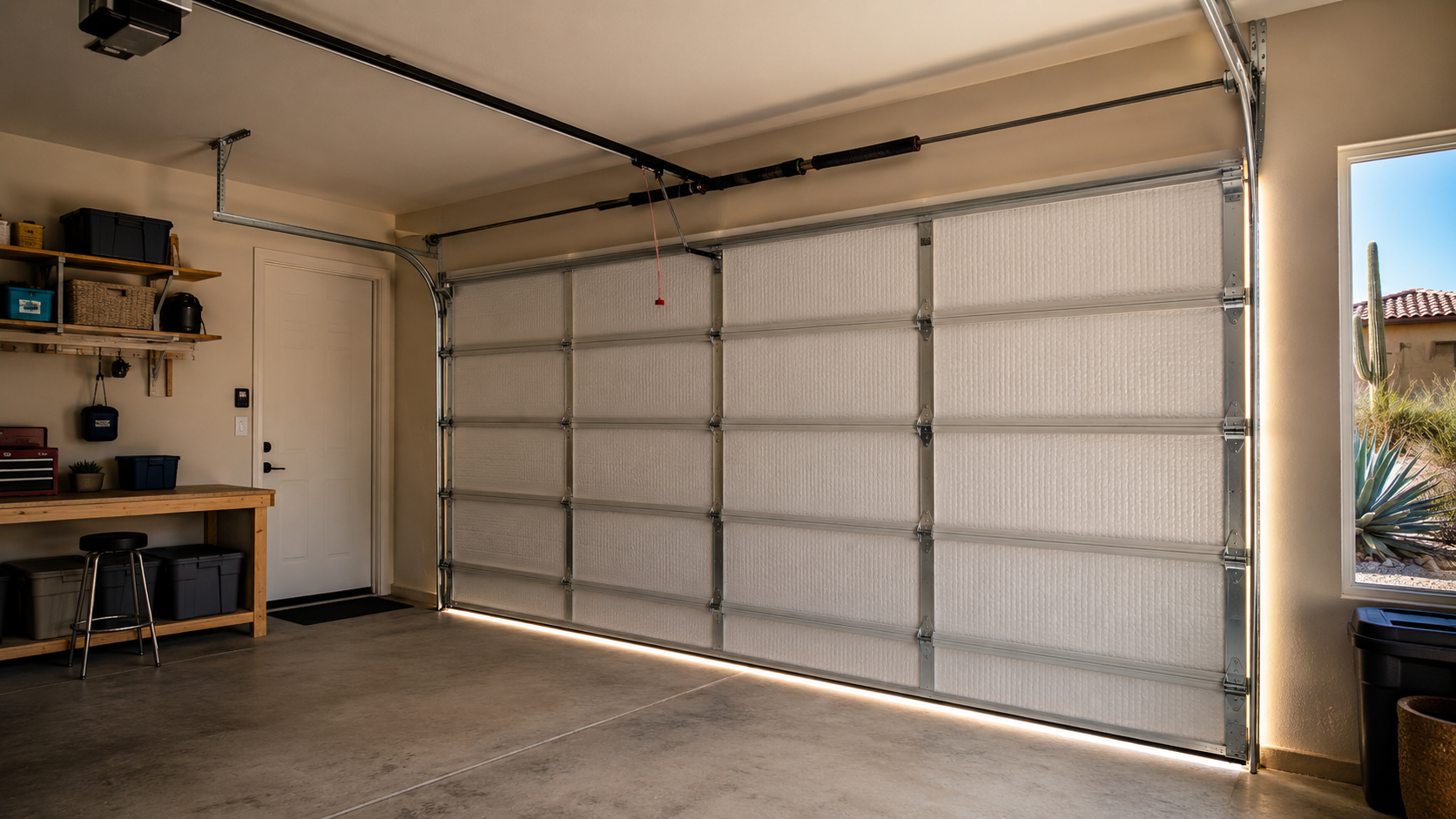
An Arizona garage can get brutally hot during the summer, but your garage door may be contributing more to the problem than you realize.
Because a garage door covers such a large portion of the exterior wall, its construction, insulation, seals, age, and sun exposure can all affect how much heat enters the garage. If the door is thin, poorly sealed, or deteriorating, the space behind it may heat up rapidly during the hottest part of the day.
That can be especially noticeable if you use your garage as a workshop, gym, storage area, hobby space, or primary entrance into your home.
It can also matter when bedrooms, offices, or other conditioned rooms share a wall or ceiling with the garage.
Here are some of the easiest ways Arizona homeowners can tell whether their garage door may need better insulation.
1. Your Garage Becomes Extremely Hot Every Afternoon
Garages are rarely as comfortable as the conditioned areas of a home, especially during an Arizona summer.
But there is a difference between a naturally warm garage and one that feels like an oven every afternoon.
If your garage temperature rises dramatically when direct sunlight hits the garage door, the door itself may be transferring a considerable amount of heat into the space.
Try this simple check
Visit your garage at three different times:
- Early morning
- Midday
- Late afternoon
Pay attention to how the temperature changes.
Then carefully feel the interior surface of the garage door. If the inside of the door becomes extremely warm when the exterior is exposed to sunlight, the door may offer limited resistance to heat transfer.
This can be especially noticeable with thin, non-insulated metal garage doors.
For Arizona homeowners considering insulation or replacement options, Garage Doors Wholesalers in Mesa supplies garage doors, parts, openers, and other garage door products.
2. Rooms Next to the Garage Feel Hotter
Sometimes the problem becomes noticeable inside the house before you think about the garage door.
If a bedroom, laundry room, hallway, or other living area that shares a wall with the garage consistently feels warmer than the rest of the home, heat from the garage may be contributing.
The same issue can occur when living space is located directly above the garage.
Your garage door is not necessarily the only factor. Wall insulation, attic insulation, air sealing, windows, and HVAC design can all influence indoor comfort.
However, reducing the amount of heat entering the garage in the first place can be one part of improving the situation.
If you’re evaluating the overall condition of your garage door, House Pros Now also has a guide explaining why garage door quality matters so much in Arizona.
3. Your Garage Door Has Little or No Insulation
One of the easiest clues is the construction of the door itself.
Open your garage and look at the interior side of the door.
Some non-insulated doors have a relatively simple construction where the inside surface of the exterior panels or framing is clearly visible.
Insulated garage doors typically contain an insulating material between layers or inside the door sections.
Depending on the door, that insulation might be:
- Polystyrene
- Polyurethane
- Insulation panels
- Another manufacturer-specific insulating system
If your door appears thin and hollow or has exposed panel cavities without insulation, it may provide significantly less thermal resistance than an insulated alternative.
Garage Doors Wholesalers supplies garage door products and serves homeowners, contractors, installers, and businesses from its Mesa location. You can learn more in the House Pros Now feature on Garage Doors Wholesalers in Mesa.
4. You Can See Daylight Around the Garage Door
Insulation inside the panels is only part of the equation.
A well-insulated door can still perform poorly if hot outside air enters through large gaps around the edges.
Close the garage door during daylight and stand inside with the garage lights off.
Look around:
- The bottom of the door
- Both side edges
- The top edge
- Between door sections
Small amounts of light may be normal depending on the installation, but obvious gaps deserve attention.
Weather seals can become brittle, compressed, cracked, or damaged over time, particularly in harsh climates.
If you can clearly see daylight around sections of the closed door, hot air, dust, and debris may also be finding their way inside.
5. The Bottom Weather Seal Is Cracked or Flattened
The flexible seal along the bottom of a garage door helps close the space between the door and garage floor.
Over time, this seal can deteriorate.
Look for:
- Cracking
- Splitting
- Missing sections
- Flattening
- Hard or brittle material
- Gaps between the seal and floor
Arizona heat can be especially demanding on materials that spend years exposed to hot pavement, dust, and temperature changes.
A damaged bottom seal does not necessarily mean you need an entirely new garage door. Replacing weatherstripping may be a much simpler improvement.
However, if poor sealing is combined with thin panels, significant age, or other deterioration, it may make sense to compare the cost of improving the existing door with replacing it.
6. The Door Panels Feel Thin or Hollow
Garage doors vary considerably in construction.
Some basic doors are primarily designed to provide security and weather protection. Others incorporate multiple layers and insulation to improve thermal performance, strength, or noise reduction.
If your existing garage door feels lightweight, has hollow sections, or appears to consist mainly of a single exterior layer, it may not offer much insulation from Arizona’s summer heat.
That does not automatically make it a bad door.
A non-insulated door can still make sense for a detached garage or space where temperature is not important.
But if the garage is attached to the house or regularly used as a workspace, insulated construction may be more valuable.
7. Your Garage Door Is Old and the Panels Are Deteriorating
Age does not automatically mean a garage door needs replacement.
However, older doors may have:
- Damaged panels
- Deteriorated seals
- Faded finishes
- Gaps between sections
- Missing insulation
- Loose hardware
- Outdated construction
If the door has been exposed to years of direct Arizona sunlight, inspect it from both inside and outside.
Look for sections that appear warped, damaged, separated, or poorly sealed.
If insulation is already present, check whether it is damaged, loose, missing, or deteriorating.
When several of these issues appear together, replacement may provide more benefit than continuing to repair individual components.
8. You Use Your Garage as More Than a Place to Park
How you use your garage should influence how much insulation you need.
Better insulation may be particularly worthwhile if your garage functions as a:
- Workshop
- Home gym
- Hobby area
- Laundry area
- Storage room
- Pet-access area
- Frequent entry point into the home
It can also be useful if you’re storing items that do not tolerate extreme temperatures well.
Insulation will not turn an unconditioned Arizona garage into an air-conditioned room, but reducing heat transfer through the garage door can help make the space more manageable.
House Pros Now’s Arizona garage door guide specifically notes that insulation kits can be useful for homeowners who use garages for workshops, storage, hobbies, fitness, or spaces adjacent to living areas.
Insulated vs. Non-Insulated Garage Doors
If you’re considering a replacement door, understanding the basic difference between insulated and non-insulated construction can help.
Non-insulated garage doors
A non-insulated door is generally the simpler option.
Potential advantages include:
- Lower initial cost
- Lighter construction
- Adequate performance for some detached garages
- Simpler replacement when temperature control is not a concern
The downside is that these doors generally provide less resistance to outdoor heat.
For an Arizona garage exposed to intense afternoon sun, that difference can become noticeable.
Insulated garage doors
An insulated garage door includes insulating material within the door sections.
Potential advantages can include:
- Reduced heat transfer through the door
- Improved garage comfort
- Better performance for attached garages
- More suitable conditions for workshops and hobby spaces
- Potentially quieter and more substantial door construction, depending on the design
The best option depends on your home, garage use, budget, and the amount of direct sun the door receives.
What Does R-Value Mean?
When comparing insulated garage doors, you may see an R-value listed.
R-value is a measure of resistance to heat flow.
Generally, a higher R-value indicates greater insulating resistance.
However, homeowners should avoid choosing a garage door based on R-value alone.
Also consider:
- Door construction
- Panel thickness
- Weather seals
- Installation quality
- Garage orientation
- Direct sun exposure
- Whether the garage is attached to the house
- How the garage will be used
A well-insulated door with significant gaps around the perimeter may still allow unwanted heat and outside air into the garage.
Should You Add Insulation or Replace the Garage Door?
Not every hot garage needs a completely new door.
If your existing door is structurally sound and operates properly, adding insulation may be an option depending on the door’s design.
An insulation kit may make sense when:
- The door itself is still in good condition
- The panels can accept insulation safely
- You’re mainly trying to reduce heat transfer
- You want a more affordable improvement than full replacement
Replacement may make more sense when:
- Panels are badly damaged
- The door is warped
- The door is significantly outdated
- Weather sealing is poor throughout
- Multiple components are deteriorating
- You already planned to replace the door
- You want a purpose-built insulated door
Before adding significant weight to an existing garage door, make sure the door and operating system are appropriate for the change.
Adding insulation changes the weight of the door, which can affect springs, hardware, balance, and opener performance.
For major modifications, homeowners should consult an experienced garage door professional.
A Quick Arizona Garage Door Insulation Check
You can perform this simple inspection without special equipment.
Check the interior door surface.
Does it appear hollow or uninsulated?
Feel the door during the afternoon.
Does the inside surface become extremely hot?
Look around the perimeter.
Can you see significant daylight?
Inspect the bottom seal.
Is it cracked, brittle, or flattened?
Examine the panels.
Are they warped, damaged, or separating?
Consider adjoining rooms.
Do they become noticeably warmer when the garage heats up?
Think about how you use the garage.
Would reducing summer heat make the space significantly more useful?
If several of these conditions apply, comparing insulation options is worthwhile.
Find Garage Door Products in Mesa, Arizona
Garage Doors Wholesalers, also known as GDW, is located in Mesa and supplies garage doors, garage door openers, parts, hardware, and related products for Arizona homeowners, contractors, installers, and businesses.
You can view the Garage Doors Wholesalers profile on House Pros Now or read more about GDW’s garage doors, openers, parts, and supplies.
For additional Arizona home-service information, visit the House Pros Now blog.
Is Better Garage Door Insulation Worth It in Arizona?
For many homeowners, the answer depends on where the garage is located and how it is used.
A detached garage used primarily for parking may not require the same level of insulation as an attached garage with a bedroom above it.
But if your garage becomes unbearably hot every afternoon, adjoining rooms are uncomfortable, seals are deteriorated, or your existing door has little insulation, an upgrade may be worth considering.
The goal is not necessarily to make the garage cold.
It is to reduce unnecessary heat transfer and make the space—and potentially the areas around it—more comfortable during Arizona’s hottest months.
To explore garage door and insulation options, visit the official Garage Doors Wholesalers website or their House Pros Now business profile.
Garage Doors Wholesalers (GDW)
Address: 9107 E Southern Ave, Suite 109, Mesa, AZ 85209
Phone: (480) 995-0498
Website: garagedoorswholesalers.com